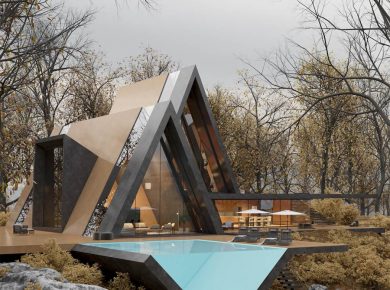
Sri Lankan designer Thilina Liyanage has built a reputation around a clear architectural philosophy. Buildings placed in natural environments should not simply occupy the landscape. They should reflect its logic, its inhabitants, and its atmosphere.
Across his conceptual work, Liyanage frequently draws inspiration from biological structures. Bird wings, insect shells, and skeletal frameworks have shaped several of his earlier designs. His latest concept pushes this biomimetic approach further than before. The Rhino Safari Deck , titled Kifaru Point , transforms a wildlife observation tower into an architectural echo of the animal it celebrates.

The project takes its name from the Swahili word kifaru , meaning rhinoceros. That linguistic choice signals the idea behind the structure immediately. From a distance, the building reads unmistakably as a rhino. Its mass sits low and heavy against the horizon. A large horn rises from the roofline. Angular protrusions resemble ears. The entire form leans forward on its base with the posture of an animal ready to charge. Rather than hiding within the landscape, the structure embraces visibility. Liyanage treats the building almost like a monumental sculpture placed within the terrain. The rhino silhouette gives the observation deck a recognizable identity long before visitors approach the stairs.
Kifaru Point functions primarily as a wildlife observation deck . The building stands on an elevated concrete plinth, lifting the structure above the surrounding scrubland. A timber-decked platform wraps around the base, creating an accessible outdoor space where visitors can gather before ascending to the main viewing area. A steel staircase rises from the rocky ground level toward the upper platform. Beneath the main body of the structure, a shaded zone offers shelter and a transitional pause in the climb. From there, the path continues upward into the rhino-shaped volume itself.

Inside the structure, large framed openings guide sightlines toward the surrounding landscape. These apertures are positioned deliberately to create panoramic views across the flat terrain below. Instead of a simple lookout tower, the architecture shapes the act of observation itself. The structure becomes part of the safari experience rather than merely supporting it.
Structurally, Kifaru Point relies on a network of triangulated steel frames . The skeletal system forms a rigid exoskeleton capable of supporting the irregular geometry of the rhino form. At every intersection, spherical steel nodes connect the angled struts. The resulting framework evokes the look of industrial construction kits or mechanical assemblies. This mechanical clarity contrasts with the organic animal shape that emerges once the structure is fully clad.
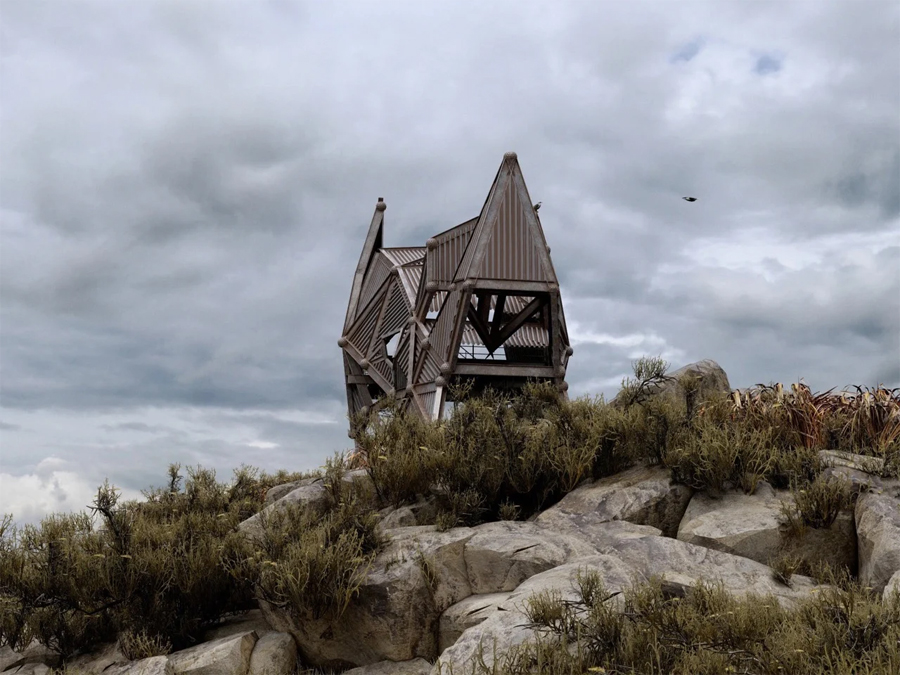
Corrugated steel panels cover the exterior surfaces. Their ribbed texture creates a layered, striated appearance across the facets of the building. From afar, the pattern resembles armored skin, reinforcing the visual analogy with a rhinoceros. The lower platform introduces timber decking, softening the metallic structure and providing a warmer material underfoot. Both materials perform well in harsh outdoor conditions, making them practical choices for architecture intended to endure remote environments.
Many eco-lodges and safari structures follow a familiar strategy. They aim to disappear into the landscape through muted colors and natural materials. Their architecture tries to remain quiet and unobtrusive. Kifaru Point chooses a different path. Rather than fading into the terrain, the building asserts itself as a landmark. It becomes a visual anchor across the open plain, something visitors can orient toward from a distance.

The rhino form also introduces a symbolic layer to the project. Rhinoceroses are ancient creatures, physically powerful yet critically endangered. Designing a wildlife observation structure that resembles the very animal many visitors hope to see transforms the building into a subtle statement about conservation. Instead of simply hosting tourism, the architecture becomes a reminder of the species that inhabit the surrounding ecosystem.
Liyanage’s visualizations place the structure within a sparse landscape of desert shrubs, rocky terrain, and tall cactus-like plants. The setting suggests environments found in southern or eastern Africa, though the design remains flexible enough to suit multiple wildlife reserves. Weathered steel tones and warm timber blend naturally with the muted greens and grays of the terrain. Overcast skies dominate the rendered scenes, giving the rhino-shaped structure a dramatic presence against the horizon. The atmospheric lighting reinforces the impression that the building already exists somewhere remote and windswept, waiting for visitors to climb its stairs and scan the plains for distant movement.

Biomimetic architecture often borrows from nature for structural advantages. Shell structures, bone patterns, and honeycomb geometries frequently inspire efficient building systems. Kifaru Point takes a different route. Its biological inspiration is primarily symbolic rather than structural. The rhino silhouette gives the project narrative weight. It links the architecture directly to the wildlife it serves to observe. In doing so, Liyanage suggests that buildings in natural environments can communicate stories about those environments rather than simply occupying them.
The Rhino Safari Deck shows how architecture can operate simultaneously as infrastructure, sculpture, and ecological statement. It demonstrates that a building placed in the wilderness does not always need to disappear. Sometimes it can stand proudly in the landscape and speak its language in the shape of the animals that belong there.