
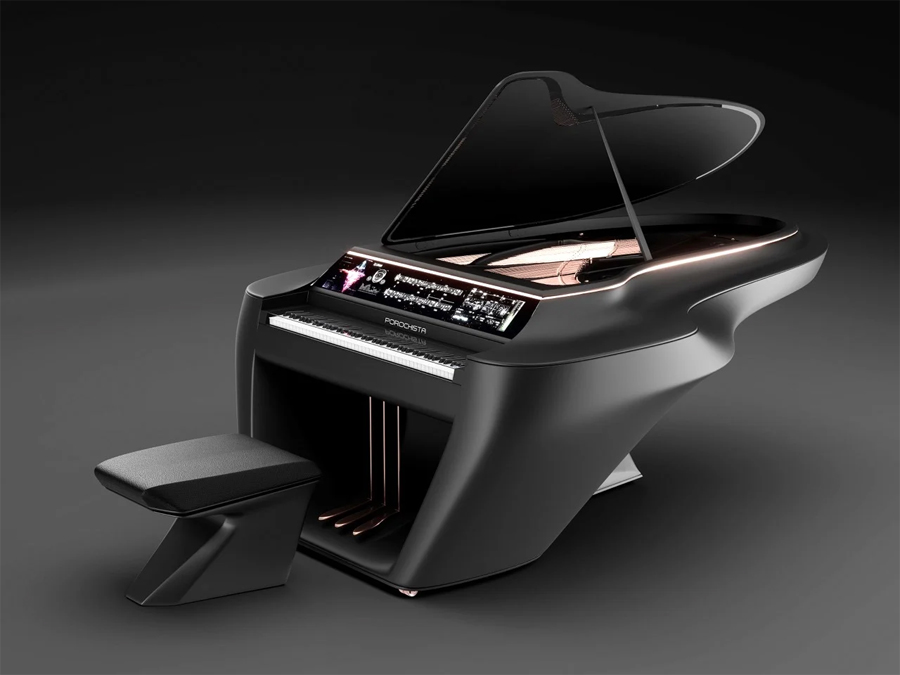
For more than two centuries, the grand piano has barely changed its visual language. Curves were refined, proportions polished, finishes modernized, yet the core silhouette stayed safely untouched. Mohammad Limucci approached this legacy not as a constraint, but as raw material. Porochista is his answer to a question few designers dare to ask. What happens if you treat a piano like a high-performance object rather than a museum piece.
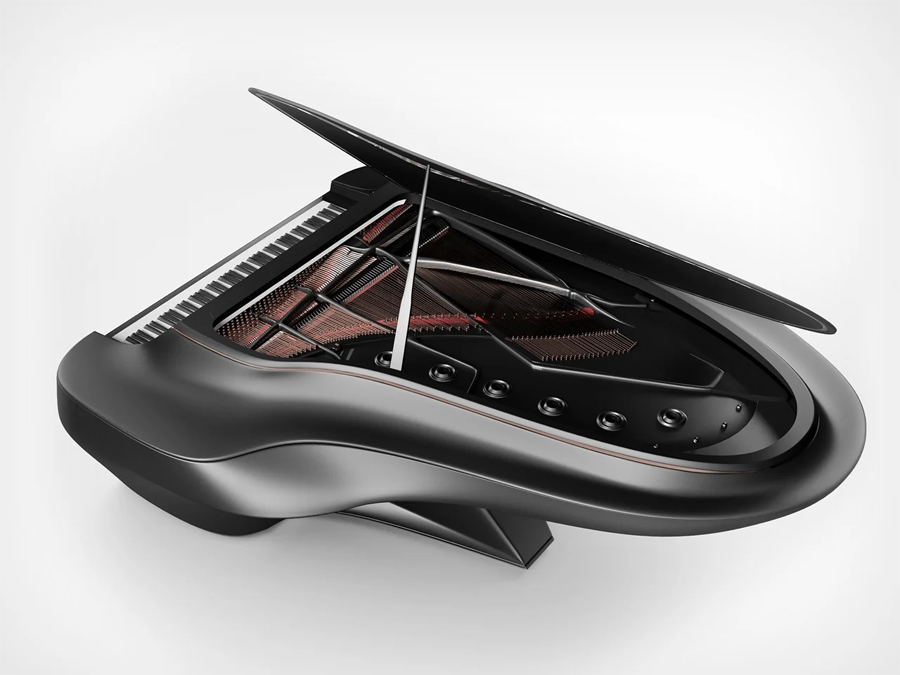
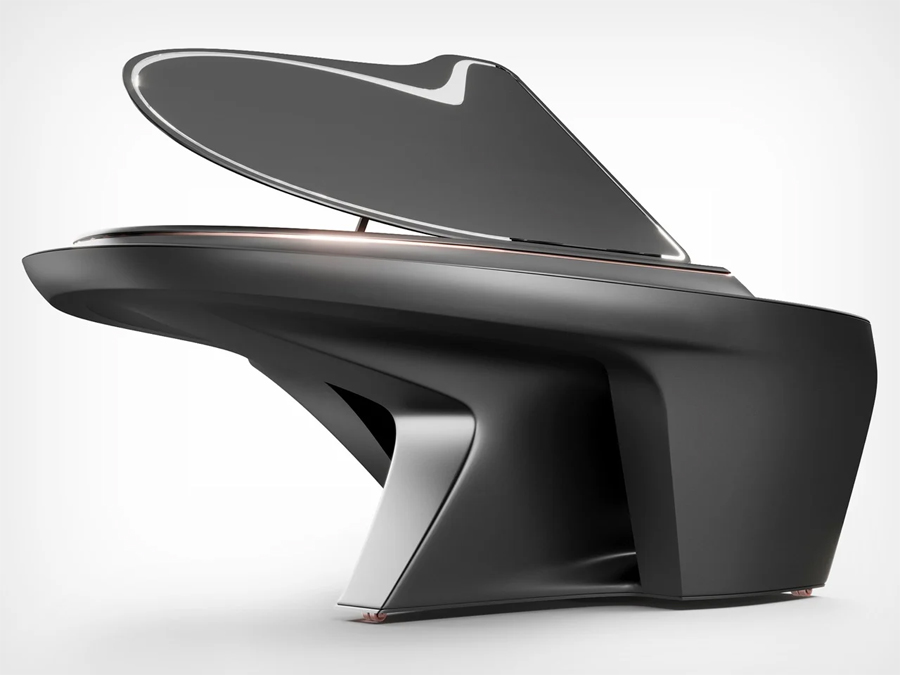
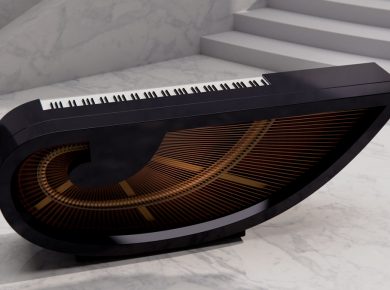
At 8.7 by 6.2 feet, Porochista has the physical presence of a concert grand, yet it resists visual heaviness. Glass, metal, and matte black composite surfaces flow into one another in long, uninterrupted lines. The rear section appears to hover, creating a deliberate tension between gravity and motion. This illusion of lightness is not decorative. Structural logic and load distribution do the real work, echoing solutions more common in automotive engineering than in instrument making.

The influence of Luigi Colani is unmistakable. Colani rejected sharp edges in favor of biomorphic continuity, arguing that nature rarely draws straight lines. Porochista follows that philosophy with conviction. Hard boundaries dissolve into organic transitions, making the instrument feel almost aerodynamic. One could imagine it accelerating forward if given space, an object designed with velocity in mind rather than static display.
Limucci openly borrows from the design logic of hypercar manufacturers such as Pagani and Koenigsegg . In those machines, every curve must justify itself both visually and mechanically. The swept-back lid, accented with metallic trim, resembles active aerodynamic elements rather than traditional piano hardware. The base features angular cutouts and geometric voids that reduce visual mass without compromising strength. This is not a trick of perception. CNC machining and advanced molding techniques are required to achieve such compound forms, placing Porochista firmly outside conventional piano manufacturing methods.
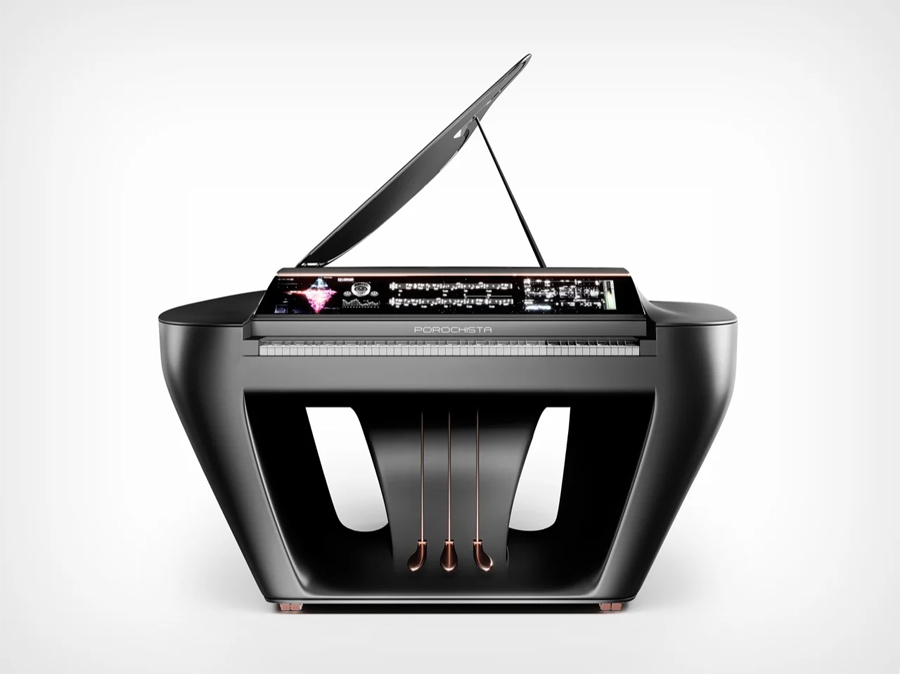
A large integrated touchscreen might sound like an unnecessary provocation, yet its execution avoids spectacle. The display sits flush within the body and focuses on functions pianists actually use. Recording, playback, and animated notation support practice and performance rather than distracting from them. A concealed sheet music compartment slides out from the top, activated by a discreet touch point. That single gesture reveals a designer who thought about hours-long interaction, not just first impressions.
Material restraint plays a crucial role. The matte black exterior absorbs light rather than reflecting it, while copper-toned pedal elements glow subtly through the structural openings in the base. The result feels deliberate and confident, never ornamental for its own sake. Presence is achieved through proportion and detail, not excess.
Porochista earned international attention through its recognition by the A’ Design Award , where jurors highlighted its balance between innovation and respect for musical heritage. That credibility matters, especially for a concept born across cultural and geographic distances, reportedly developed between Tehran and Zagreb. Whether the piano reaches full-scale production remains uncertain. The complexity alone suggests it will not become a mass-market instrument.
Even so, Porochista makes a larger point. Other industries reinvent their icons regularly, while musical instruments often remain frozen in time. Limucci’s piano argues that reverence for tradition does not require visual stagnation. Professional musicians live and perform in contemporary spaces. Their instruments can do the same without sacrificing acoustic integrity.


1 comment
Жаль.что ни слова о качестве звучания инструмента.Совершенство формы всего лишь прелюдия