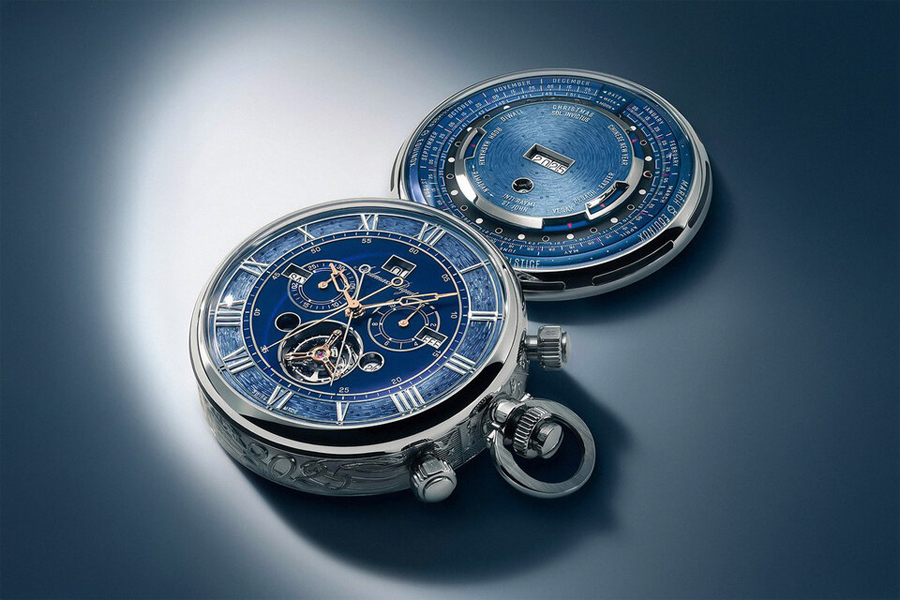
For its 150th anniversary, Audemars Piguet made a deliberate and symbolic decision to step away from the wrist and return to the object that historically allowed the brand to push mechanical watchmaking to its absolute limits. The 150e Héritage pocket watch is not a nostalgic exercise. It is a technical statement that connects the Manufacture’s most extreme historical achievements with its most recent breakthroughs in ergonomics, acoustics, and calendar engineering. In doing so, it places itself naturally in conversations about the most expensive watches in the world, not through marketing spectacle, but through sheer mechanical ambition.
The conceptual roots of the 150e Héritage reach back to two legendary Audemars Piguet pocket watches. L’Universelle from 1899 and La Grosse Pièce from 1921 defined what ultra-complication meant long before the wristwatch era. Those creations were not limited by size, thickness, or production efficiency. They existed to test the outer boundaries of what mechanical timekeeping could express. The new pocket watch follows the same philosophy, while also drawing a clear line through later milestones such as the first perpetual calendar wristwatch with leap year indication in 1955, the ultra-thin calibre 2120/2800 in 1978, and the brand’s recent ergonomic high-complication calibres like 7138, 7136, and 1000.
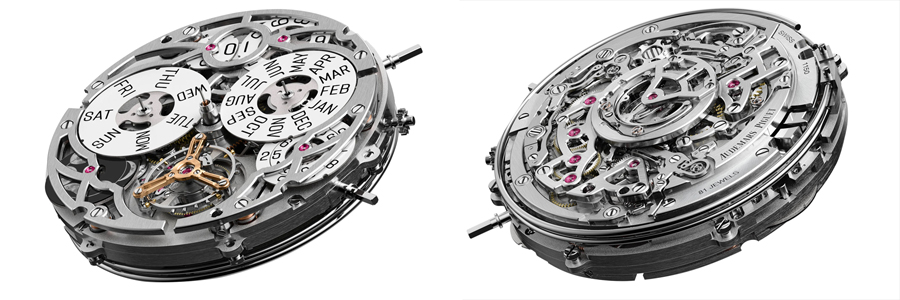
At the heart of the 150e Héritage sits an entirely new movement, Calibre 1150, paired with a concept never before realised in watchmaking. The Universal Calendar is a mechanical, independent calendrical calculator that connects solar, lunar, and lunisolar systems on a single display. This is not a variation of a perpetual calendar. It is a separate mechanical brain that uses the Gregorian calendar merely as a reference point while compiling cultural, astronomical, and civil cycles into one coherent panoramic view.
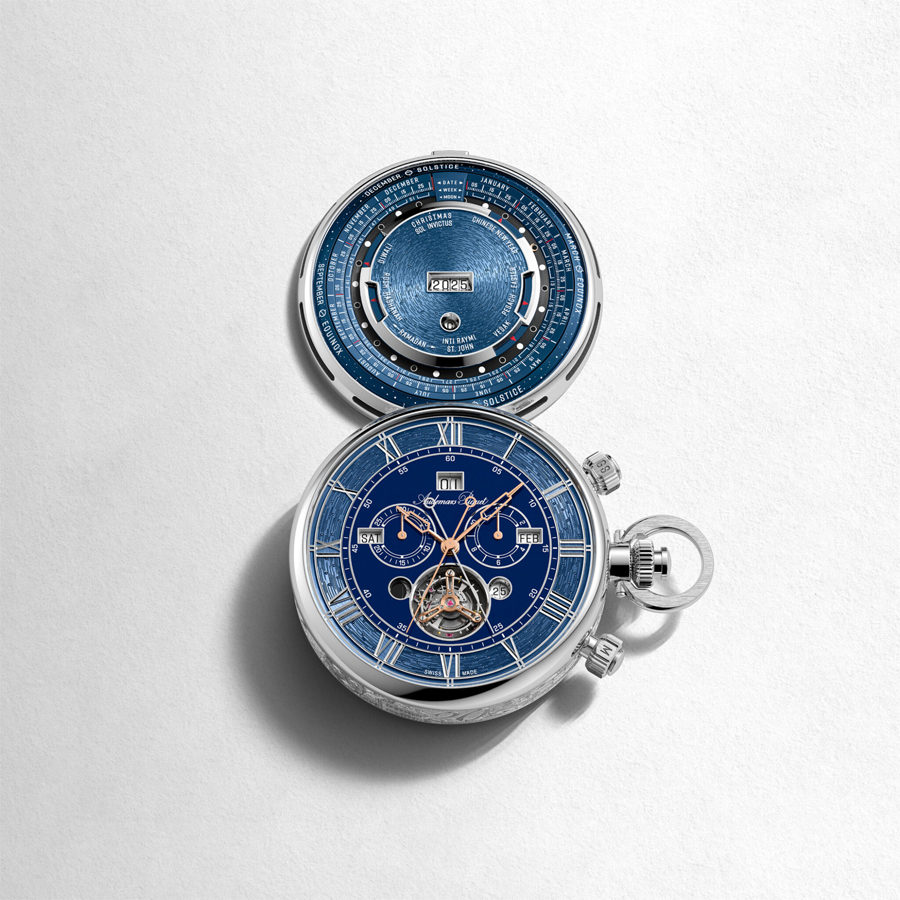
The physical scale of the watch leaves no doubt about its intended use. The 50 mm platinum case and its 23.4 mm thickness would be impractical on a wrist, yet they feel logical in the hand. This size allows for extreme mechanical density without compromise. Audemars Piguet re-engineered the entire case architecture so that crown-pushers and correctors are regrouped, symmetrical, and protected against accidental activation. Extensive 3D modelling and real-world testing shaped the tactile response of each control, reflecting the same design thinking that led to the patented all-in-one crown system found in the latest perpetual calendar wristwatches.
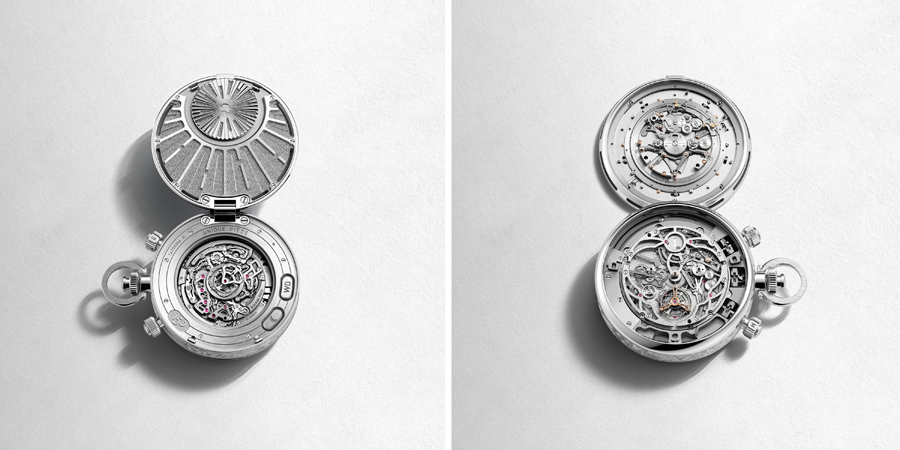
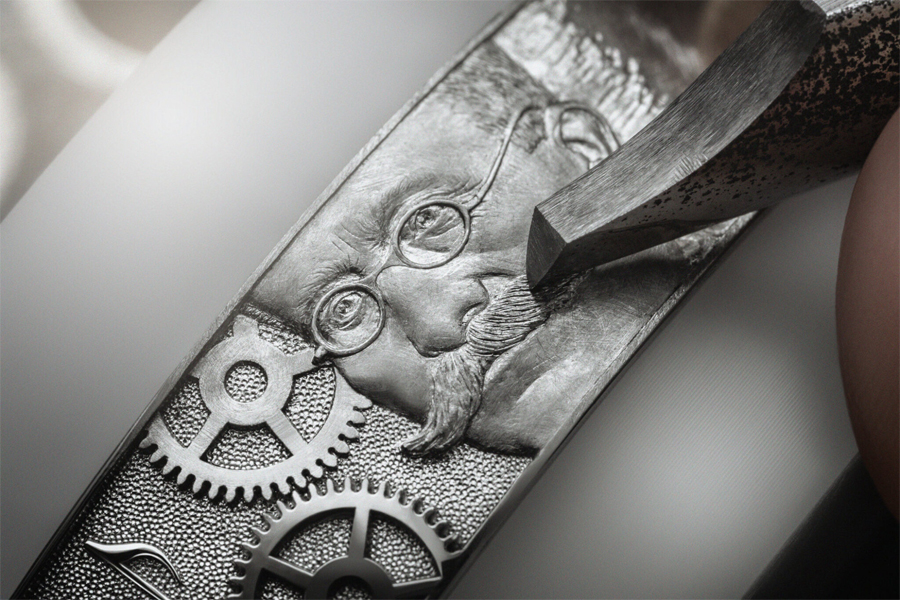
A discreet push-piece at 6 o’clock releases the secret caseback, opening it a full 180 degrees. Inside, the caseback becomes part of the mechanism itself. It functions as a sapphire Supersonnerie soundboard, enhancing acoustic performance while offering an unobstructed view of both the movement and the Universal Calendar. The exterior of the case is hand-engraved, with all functional elements confined to a limited area. The remaining surfaces are devoted to Audemars Piguet’s history, including portraits of the founders and the 150-year anniversary emblem, turning the object into a narrative as much as a timekeeper.
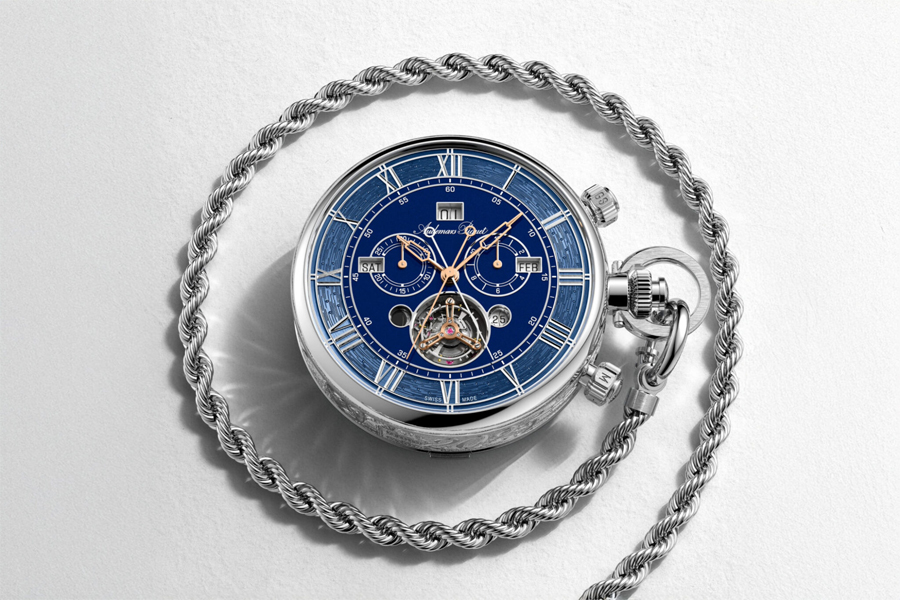
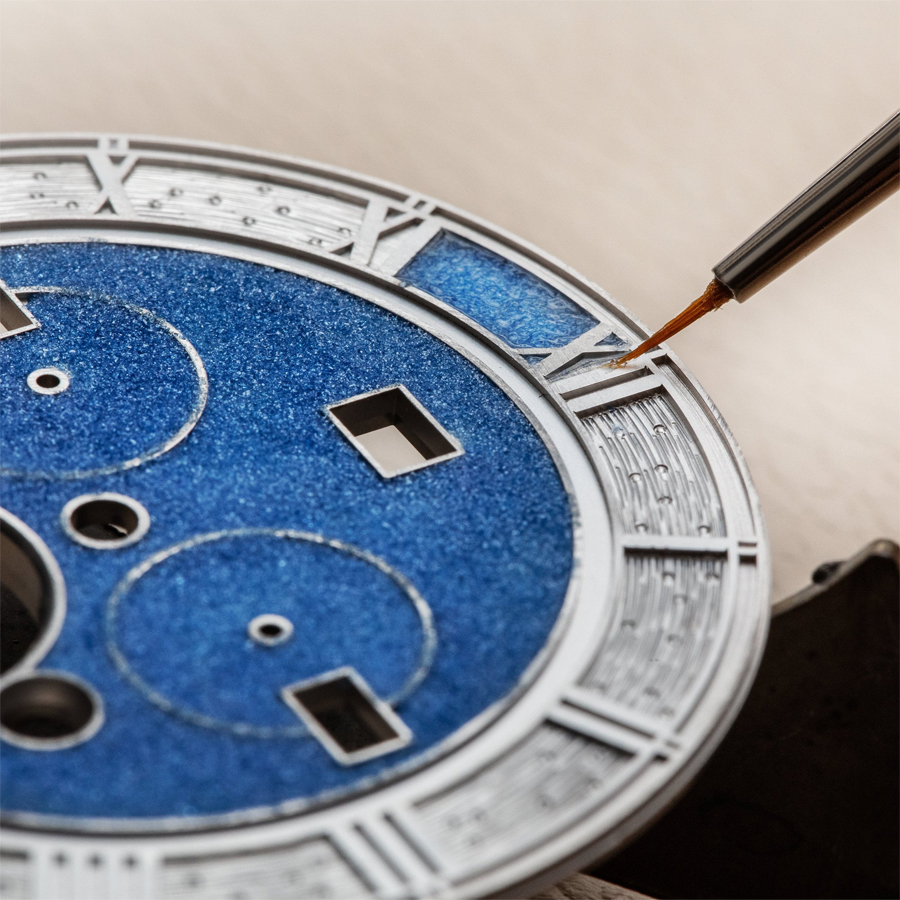
The main dial continues this fusion of mechanics and art. Crafted in 18-carat white gold, it is finished with blue translucent grand feu enamel. Hand-engraved Roman numerals sit above star-trail motifs, reinforcing the astronomical theme that runs throughout the watch. Pink-gold hands provide contrast and warmth, echoing the tone of the tourbillon bridge, while the split-seconds hand is rendered in white gold. The Universal Calendar dial mirrors this aesthetic, with engraved star trails filled with blue enamel and titanium-toned indication discs.
Calibre 1150 is derived from the Calibre 1000, also known as the Universelle and introduced in 2023, yet it has been profoundly reworked for pocket-watch use. The oscillating weight has been removed, activation systems redesigned, and the architecture adapted for manual winding. The movement comprises 1,140 components, offers a minimum power reserve of 60 hours, and operates at 21,600 vibrations per hour. In total, it integrates 40 functions and 22 complications. When the Universal Calendar is included, the numbers rise to 47 functions and 30 complications within a single object.
Its headline complications read like a catalogue of haute horlogerie at its most uncompromising. Grande Sonnerie, Petite Sonnerie, and a minute repeater are enhanced by Audemars Piguet’s patented Supersonnerie technology. A split-seconds flyback chronograph features a semi-instantaneous minute counter and a dragging hours counter. A flying tourbillon with large amplitude anchors the regulating organ. The semi-Gregorian perpetual calendar remains accurate until the year 2399, while the astronomical moon and precise moon-phase displays reinforce the celestial theme. Despite this density, legibility is carefully preserved. Calendar indications appear in dedicated apertures, leaving the chronograph counters clean and readable.
Operation is centralised around three crown-pushers. The multifunction control at 2 o’clock starts and stops the chronograph, selects chiming modes, and activates the minute repeater via a pull function. The main crown-pusher at 3 o’clock manages winding, bidirectional date correction, time-setting, and split-seconds activation through a patented return system linked to the stem. A push-piece at 4 o’clock resets the flyback chronograph and adjusts the month forwards or backwards, returning automatically to neutral after each use. Additional correctors for the weekday and moon phase are hidden beneath the caseback, preserving visual balance.
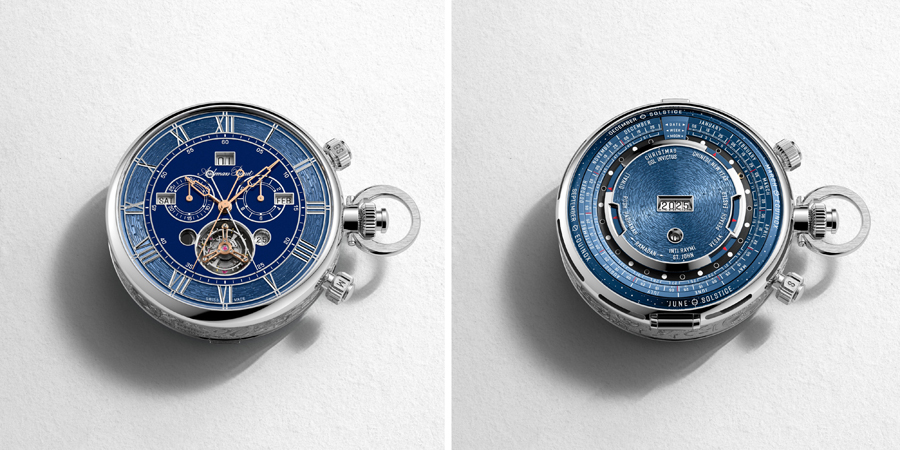
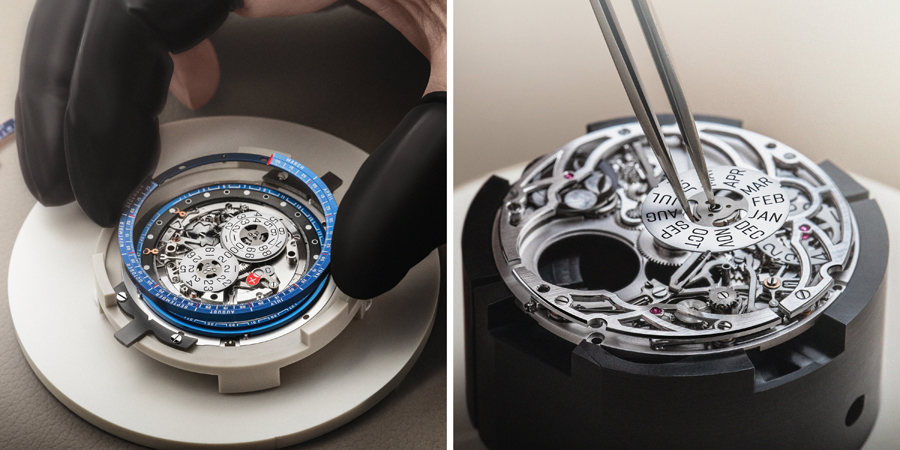
The most original element remains the Universal Calendar itself. Housed within the caseback cover, it operates independently of the main movement. Traditional perpetual calendars are locked to a single civil system. This mechanism is different. It compiles eight complications and seventeen indications, presenting year, leap years, months, dates, and weeks alongside moon phases, lunisolar dates, solstices, and equinoxes. It also tracks nine major cultural celebrations derived from solar, lunar, and lunisolar calendars, including Christmas, Ramadan, Diwali, Easter, Vesak, Rosh Hashanah, and Chinese New Year.
A bidirectional wheel on the caseback advances the system. One complete rotation moves the calendar through a full Metonic cycle of nineteen years, synchronising lunar and solar rhythms. The mechanism covers the period from 1900 to 2099 and remains accurate regardless of the watch’s power reserve, underscoring its role as an autonomous mechanical calculator rather than a dependent display.
The watch is delivered with a hand-made platinum chain, a detail that reinforces its identity as a complete object rather than a movement placed in a case. Production is limited to just two unique platinum pieces, with white-gold variations planned. Pricing is available only on request, but the scope, rarity, and complexity make its positioning clear. The 150e Héritage is not merely a celebratory piece. It is a modern reference point for what is mechanically possible, and a reminder that at the very top of watchmaking, innovation still defines the most expensive watches in the world.



![Audemars Piguet [RE]Master02 Watch" title="Audemars Piguet [RE]Master02 Watch](https://www.beautifullife.info/wp-content/uploads/2024/06/general-390x290.jpg "Audemars Piguet [RE]Master02 Watch")