There is a particular kind of underdog story that motorsport tells better than any other sport. The story of a machine that has no business being where it is, against competition that was purpose-built for exactly that environment – and winning anyway. The 1984 Paris-Dakar Rally produced one of the finest versions of that story. Porsche entered a modified 911 into nearly 6,200 miles of desert, dunes, and punishing terrain, against vehicles that had been engineered from the ground up for off-road punishment. The 911 won outright. It remains one of the most improbable results in rally history, and it has never quite received the recognition it deserves.
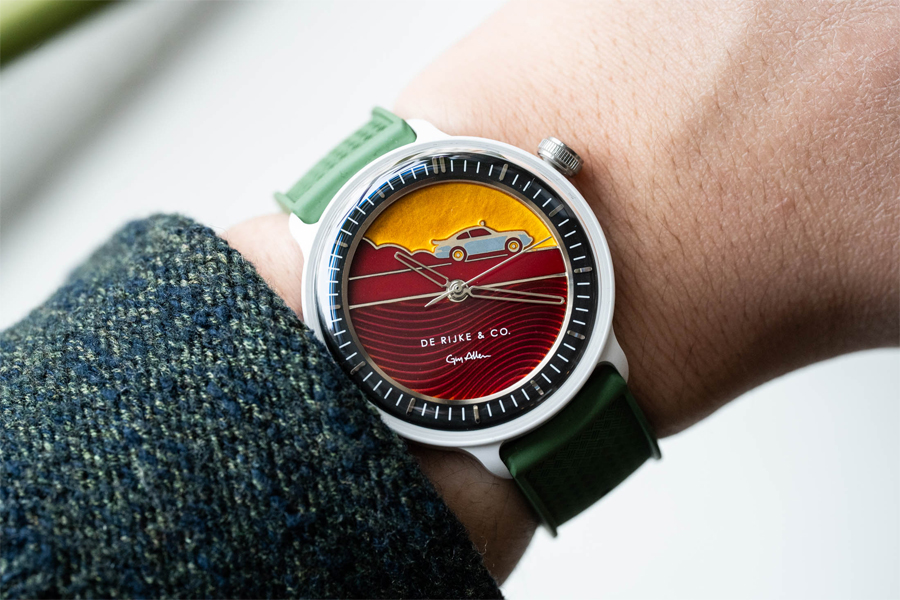
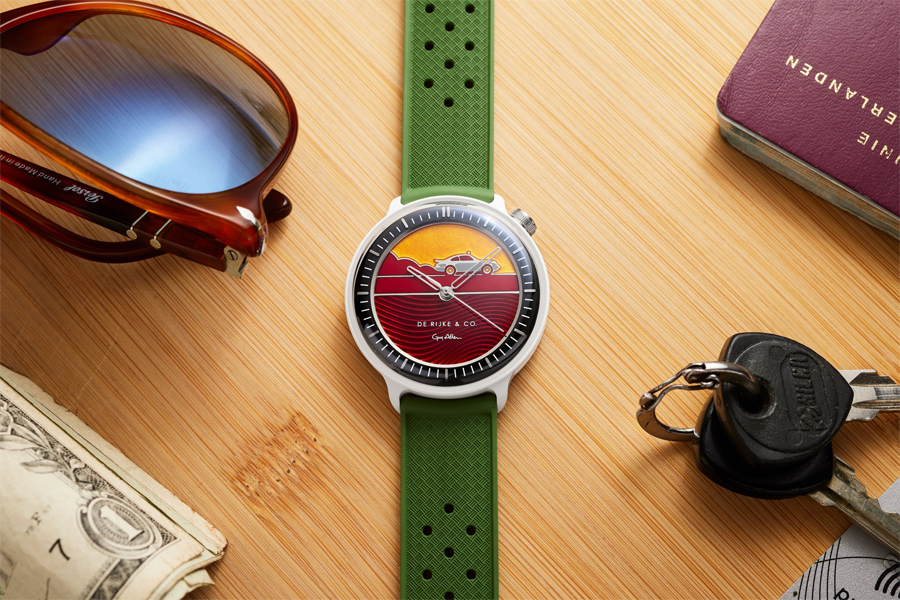
De Rijke & Co. appears to think the same. The Dutch independent watchmaker’s latest collaboration with British automotive illustrator Guy Allen is called the Amalfi Sahara, and its enamel dial shows a Porsche 911 throwing a plume of dust across open desert. It does not name the race. It does not need to. Anyone who knows the story will recognise it immediately, and anyone who doesn’t will be curious enough to find out.
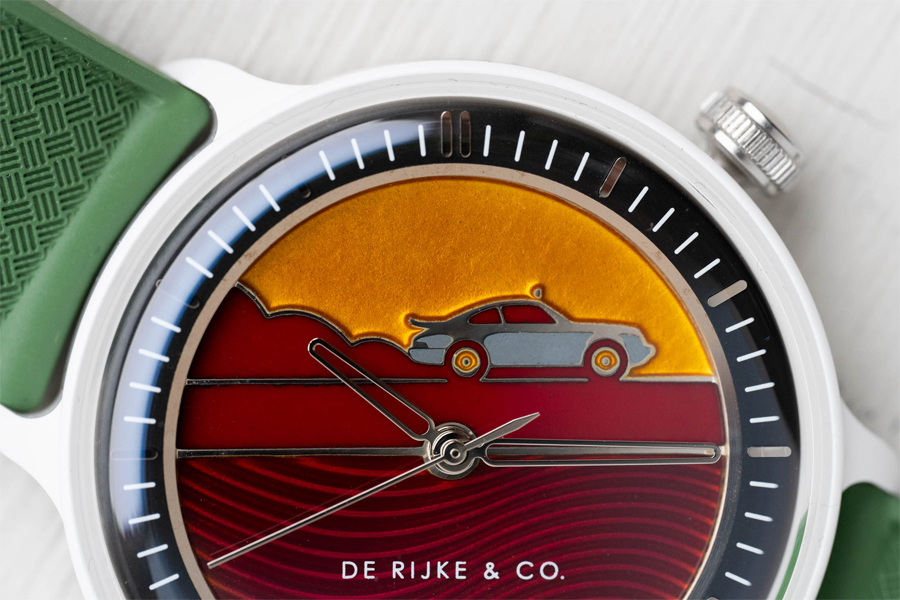
While De Rijke & Co. and Guy Allen have been working together for nearly a decade, their first set of watches arrived in 2024, establishing the Amalfi special editions with three models themed around air, land, and sea. The Sahara is part of the second series, which takes the automotive theme more literally, with three historic cars placed in the environments you might actually drive them through: a Land Rover Defender in the Amazon, a Porsche 911 in the Sahara, and a Lancia Stratos in the mountain passes of the Turini.
Each model is limited to 50 numbered pieces – double the edition size of the first series – and each one is, in the truest sense, a miniature artwork.
The dials are produced using traditional champlevé enamel techniques, beginning with a solid 925 silver base that is engraved to create recessed sections. Grand feu enamel is then applied by hand and fired at high temperature, a process in which even minor deviations in technique can result in failure. The enamelling itself is carried out by master enameller Andy Roberts, with finishing completed back at the De Rijke atelier in Dordrecht.
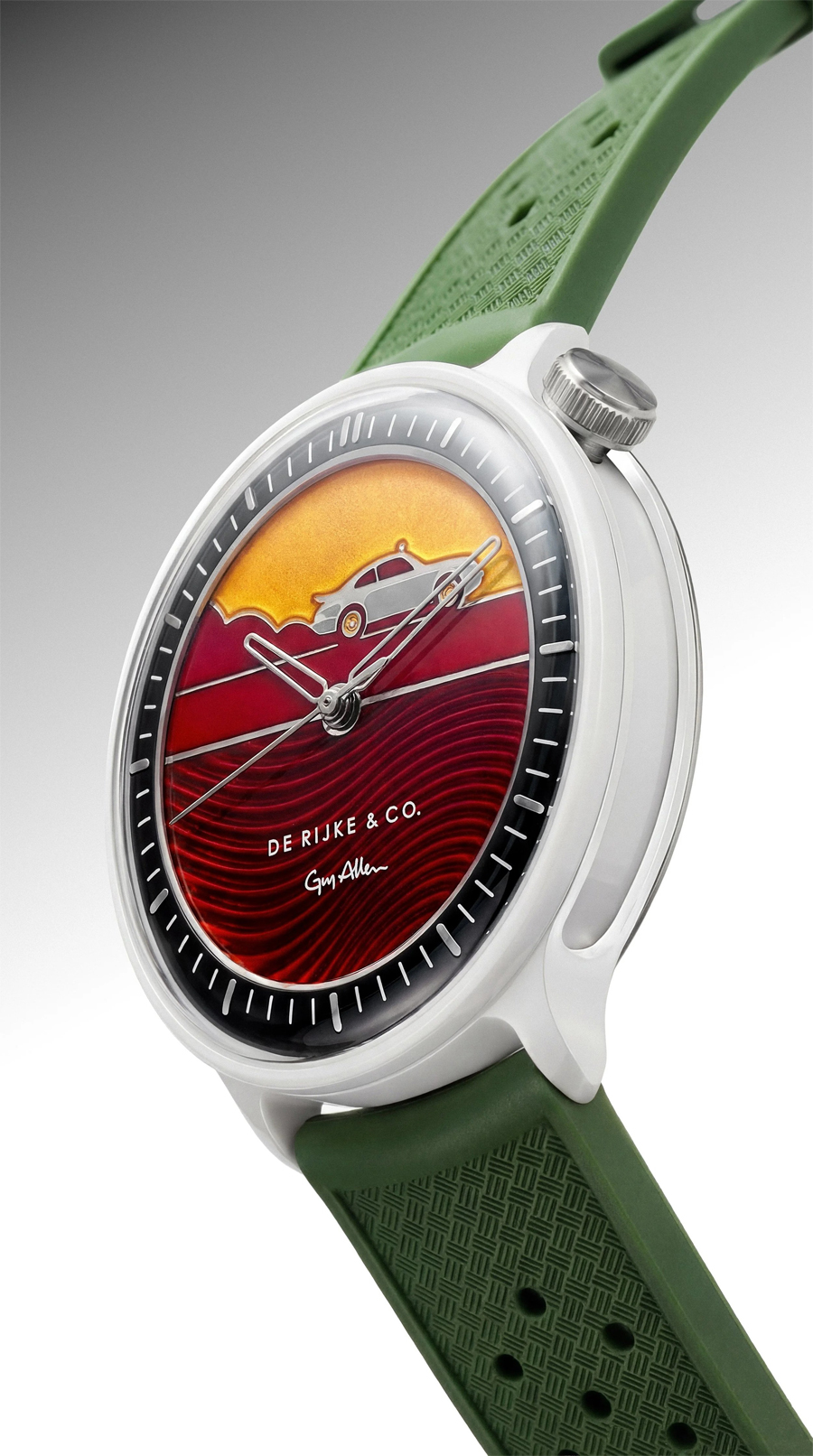
The Sahara takes the process a step further than the first series. The lower half of each dial now features three-dimensional engraving with subtle variations in depth, encased in a polished layer of transparent grand feu enamel – a technique that gives the desert surface beneath the Porsche a texture and physical presence that flat enamel cannot achieve. The upper half carries the illustration: the car, the dust cloud, the horizon. Together, the two halves feel less like a watch dial and more like a scene you are looking into rather than at.
Where earlier Amalfi editions used stainless steel, De Rijke & Co. undertook the time-consuming process of developing a fully ceramic two-piece case for the new series – a significant upgrade in both material quality and visual refinement. The case measures 38.2mm in diameter and 11mm in thickness, retaining the proportions that have defined the Amalfi collection since its beginning.
The defining feature of the case remains the rotating mechanism. The two-piece construction allows the inner case to rotate within the outer lug case, letting the driver angle the dial for a clear read while their hands remain on the wheel. It is one of those solutions that feels obvious in retrospect and was clearly anything but in practice – the engineering challenge was to integrate the rotating function while keeping the watch elegant, a balance Laurens de Rijke solved by developing a slot in the lug case through which the crown can travel as the inner case turns. A sapphire crystal sits above the dial; the caseback carries a dedicated engraving matched to the Sahara theme.
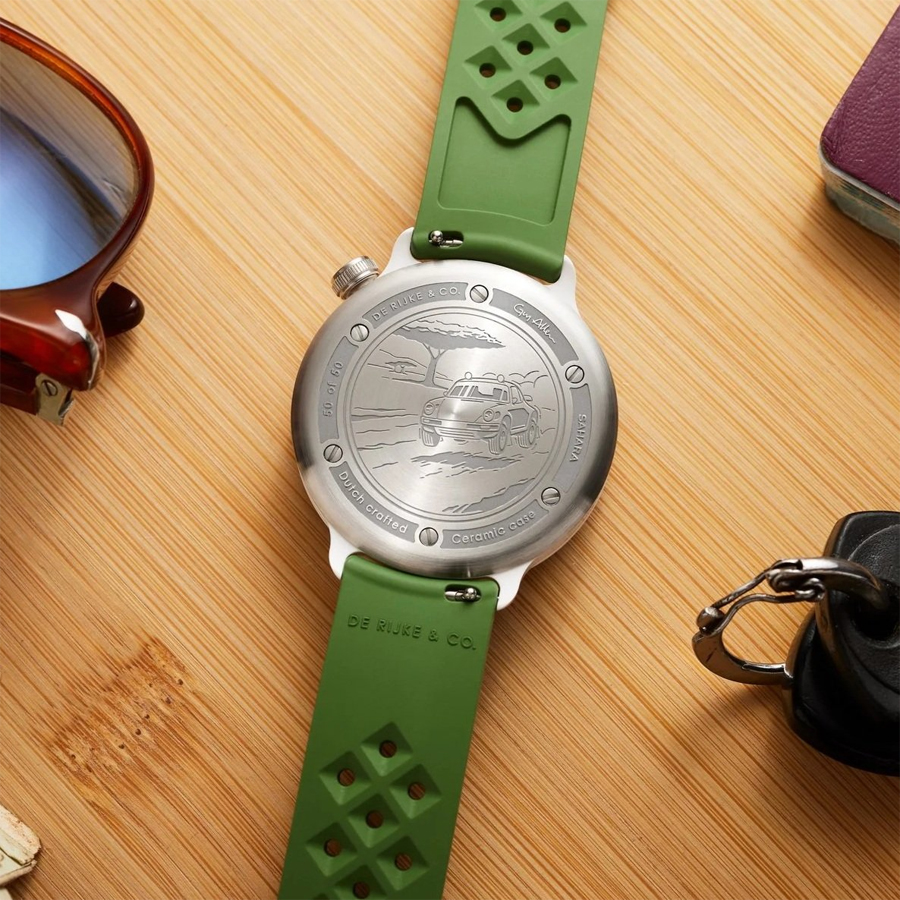
Inside sits a high-grade Sellita SW300 automatic, operating at 28,800 vibrations per hour and offering approximately 42 hours of power reserve, with a stop-seconds mechanism for precise time setting. It is a quietly excellent choice – slim enough to keep the watch at 11mm, reliable enough to be forgotten about, and just upmarket enough to suit a watch at this price point.
At €4,595 excluding VAT – approximately $5,300 – the Amalfi Sahara sits at a price that initially sounds ambitious for an independent microbrand. The context changes that calculation considerably. When you factor in the métiers d’art enamel dial and the full ceramic case construction, the value proposition becomes considerably more compelling. Enamel dials at this level of detail are genuinely rare at any price. The ceramic case development alone represents a significant investment for an atelier of De Rijke & Co.’s size.
What the Amalfi Sahara ultimately offers is something that the watch industry’s larger players rarely manage at this price: a single object with a clear point of view, made with genuine craft, referencing a story worth knowing. The 1984 Dakar 911 won against machines that were built to beat it. This watch, in its own modest way, operates on similar logic – it has no business being this good for what it costs, and yet here it is. And be sure to check the article What Watches are Good Investments?
First orders will ship in July 2025, with remaining pieces following throughout the year. All 50 will go.