On Christmas Eve 1968, astronaut Bill Anders looked out of Apollo 8’s window and saw something no human had ever seen before: Earth, whole and luminous, rising above the lunar horizon. He grabbed a camera and took what became arguably the most reproduced environmental photograph in history. That single image reframed humanity’s relationship with our planet – a pale blue marble suspended in the absolute black of space.
Fifty-eight years later, the Artemis II crew did something almost identical, pointing their cameras backward as Orion swung behind the Moon and capturing Earth in the act of setting below the lunar limb. That photograph, taken April 6, 2026, existed for barely nine days before LEGO builder BuildingDreams submitted an Ideas project to immortalize it in brick form.
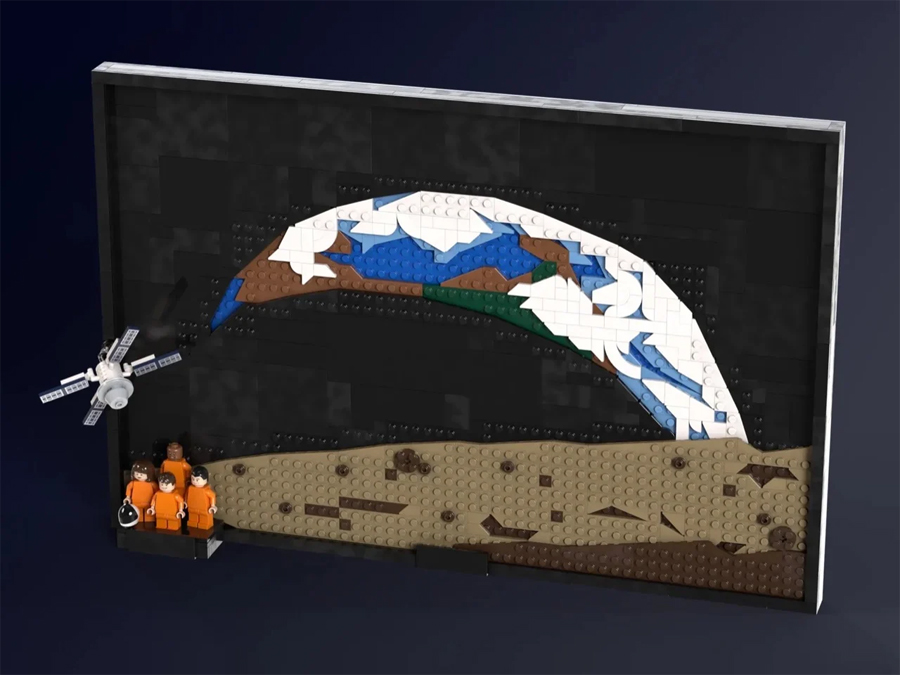
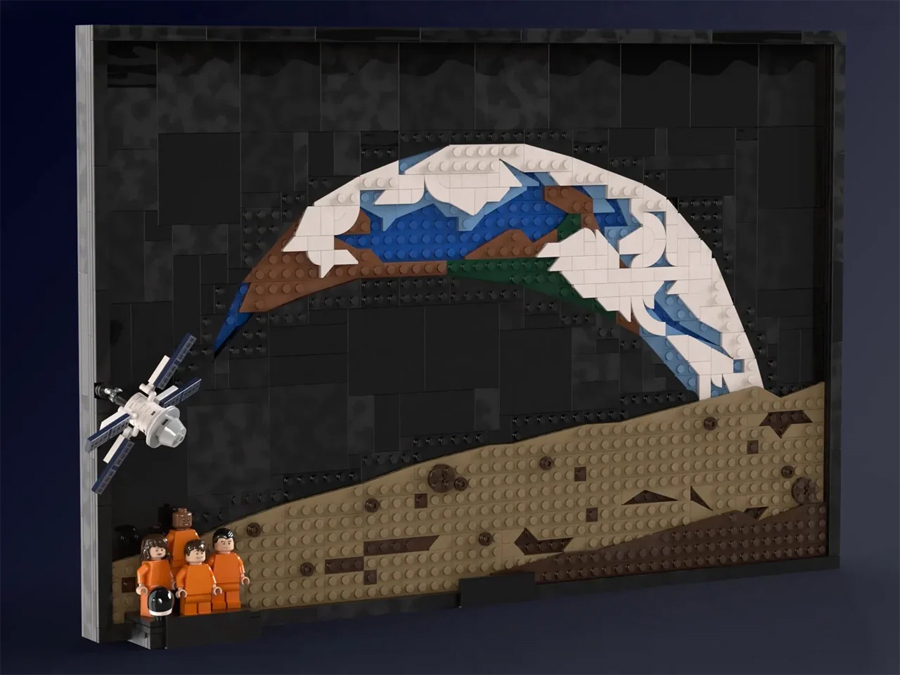
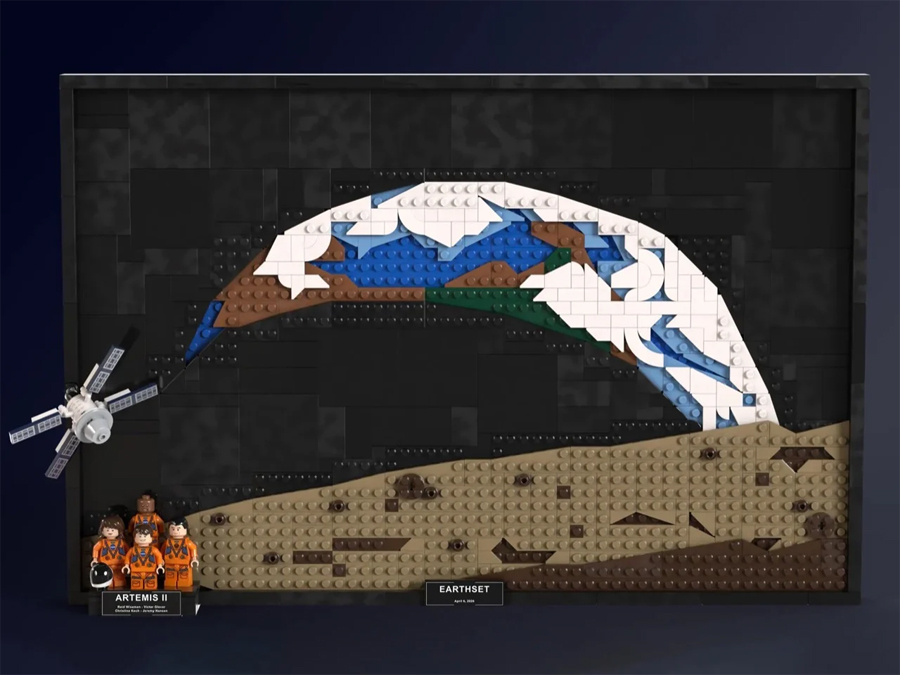
The Earthset mosaic is a 48 by 32 centimeter wall-art panel that translates the soft curves of Earth’s atmosphere, the brown and blue patchwork of continents and ocean, and the pale grey sweep of lunar regolith into a grid of plastic studs with a faithfulness that genuinely stops you mid-scroll.
The build sits in the tradition of LEGO’s own Art series – that line of large-format mosaic panels designed to function as legitimate wall decor rather than shelf clutter. The panel frame is clean and silver-edged, the depth a slim 2.8 centimeters, and the overall composition respects the original photograph’s balance: vast black space occupying the upper field, the Earth arc sweeping across the middle, and the lunar surface anchoring the bottom in tan and brown. What makes it work as a mosaic is the restraint. The builder resists the temptation to over-detail the Earth itself, letting the contrast between white cloud cover, deep ocean blue, and brown landmass do the compositional heavy lifting.
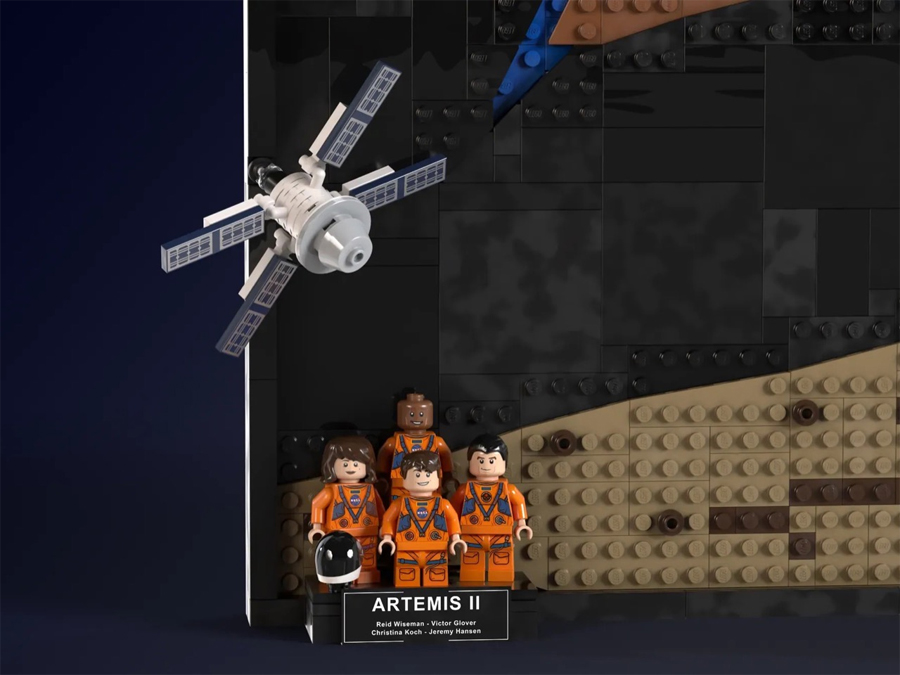
The detail that elevates this above a flat mosaic exercise is the Orion spacecraft, rendered in three dimensions and mounted to the left edge of the panel, solar panels spread wide, jutting out into the room. It breaks the picture plane in exactly the right way – a reminder that this photograph had a photographer, that four humans were inside that capsule watching Earth disappear below the Moon. Beneath the spacecraft, four minifigures stand on a small stepped platform labeled ARTEMIS II, representing Commander Reid Wiseman, Pilot Victor Glover, and Mission Specialists Christina Koch and Jeremy Hansen. The orange Orion Crew Survival System suits are printed with NASA and CSA mission patches, precise enough that you can identify Hansen by the Canadian Space Agency insignia on his chest.
BuildingDreams has noted that Earthset is designed as a companion to their previous Earthrise project – the two panels intended to hang side by side as a kind of 58-year conversation between Apollo 8 and Artemis II. That framing transforms what could have been a simple commemorative build into something genuinely poetic: two photographs of the same planet from the same distance, taken by different generations of humanity, united in plastic brick on a single wall. For anyone with the wall space, the pair would be remarkable – the kind of display that makes a room rather than merely occupying it.

To understand how ambitious the Earthset proposal really is, consider what LEGO has been producing at the high end of its catalog. The biggest LEGO set currently available by piece count is the LEGO Art World Map at 11,695 pieces – a wall-art mosaic, incidentally, not unlike what BuildingDreams is proposing. The recent Death Star, launched in October 2025 at $999.99, became both the most expensive LEGO set ever released and the biggest LEGO set in the Star Wars line, a cross-section build with six complete floors and 38 minifigures. And arriving June 1, 2026: the Lord of the Rings Minas Tirith at 8,278 pieces, the largest LOTR set ever produced. The pattern is unmistakable. LEGO’s adult collector market has an enormous appetite for large, display-worthy, emotionally resonant builds – exactly the category Earthset occupies. The Art series in particular demonstrates that wall-hanging mosaics at scale have a proven retail audience. BuildingDreams is not pitching a niche curiosity; they’re pitching something that fits squarely into LEGO’s most commercially successful adult format.
LEGO Ideas is the community platform where fan-designed builds gather votes toward a 10,000-supporter threshold, at which point LEGO’s internal team formally reviews the submission for potential production as a retail set. Earthset is currently sitting at just over 530 supporters with nearly 586 days left on the clock. The math is not daunting: 10,000 supporters across 586 days is roughly 17 new supporters per day. Given that the project captures both the LEGO community and the space photography community, that is entirely achievable – if people know it exists. If you want to see this one make it to store shelves, head to the LEGO Ideas page and cast your vote.