
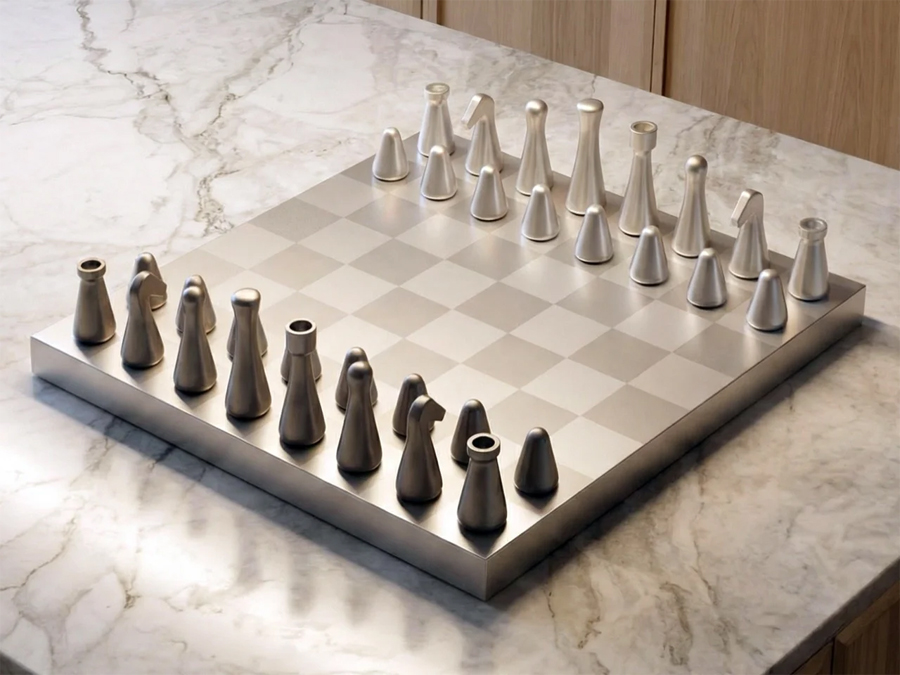
Chess has survived for centuries because its fundamentals never change. The board remains the same. The rules remain the same. The tension between strategy and creativity remains as compelling today as it was hundreds of years ago. What does change is the way designers interpret the objects that bring the game to life.
The Stoa chess set, designed by Fabian Haydt, offers a contemporary perspective on one of the world’s most recognizable games. Instead of relying on traditional ornamentation, intricate carvings, or historical references, Stoa embraces a philosophy of reduction. It asks a simple question: how much can be removed while preserving the identity and function of every piece?
The answer is a chess set that feels both timeless and unmistakably modern.
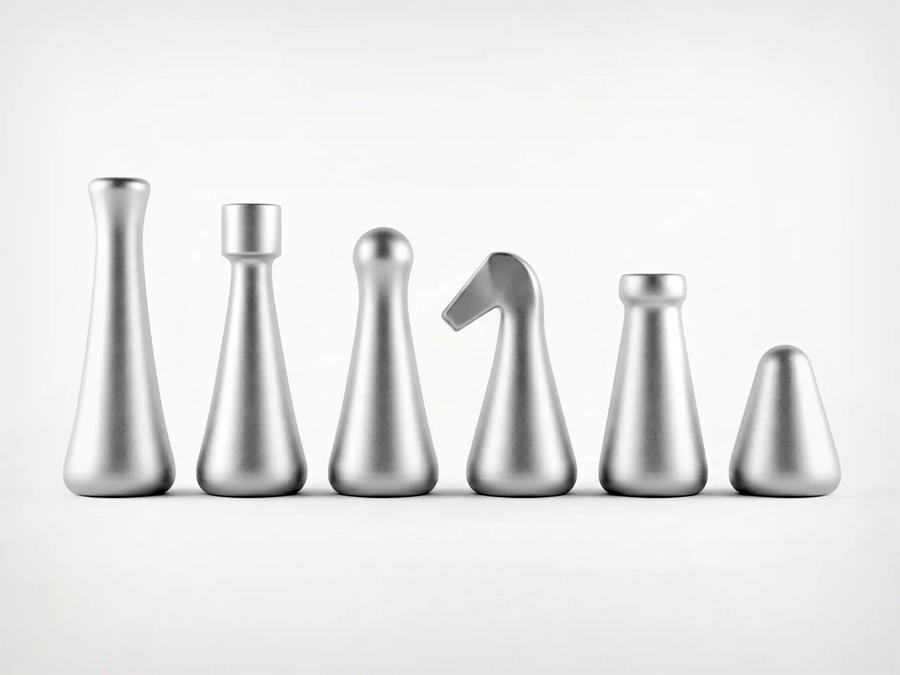
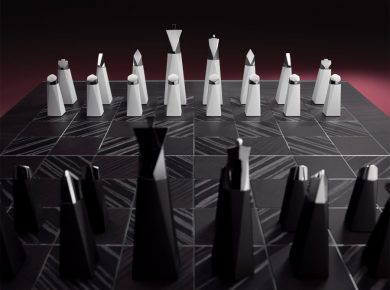
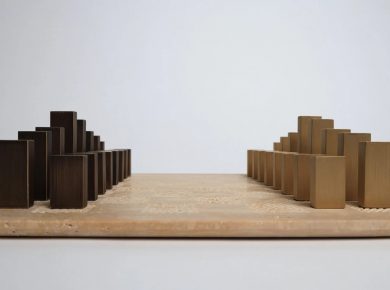
Rooted in Scandinavian design principles, Stoa prioritizes clarity, balance, and visual restraint. Every piece has been distilled to its essential geometry, creating a collection of forms that feel more like architectural objects than decorative game pieces. The result is elegant without being flashy and minimal without becoming anonymous.
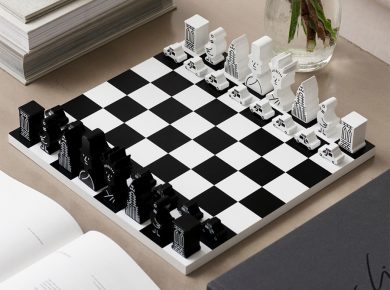
One of the most impressive achievements of the design is its ability to remain instantly recognizable. Minimalism can often drift into abstraction, forcing users to spend extra time interpreting an object. Stoa avoids that trap. Each piece maintains a clear identity, allowing players to distinguish the King, Queen, Bishop, Knight, Rook, and Pawn at a glance.
This clarity serves a practical purpose. Chess is a game of concentration, and visual distractions can interfere with the player’s ability to quickly assess a position. By stripping away unnecessary detail, Stoa creates a cleaner playing experience where attention remains focused on strategy rather than decoration.
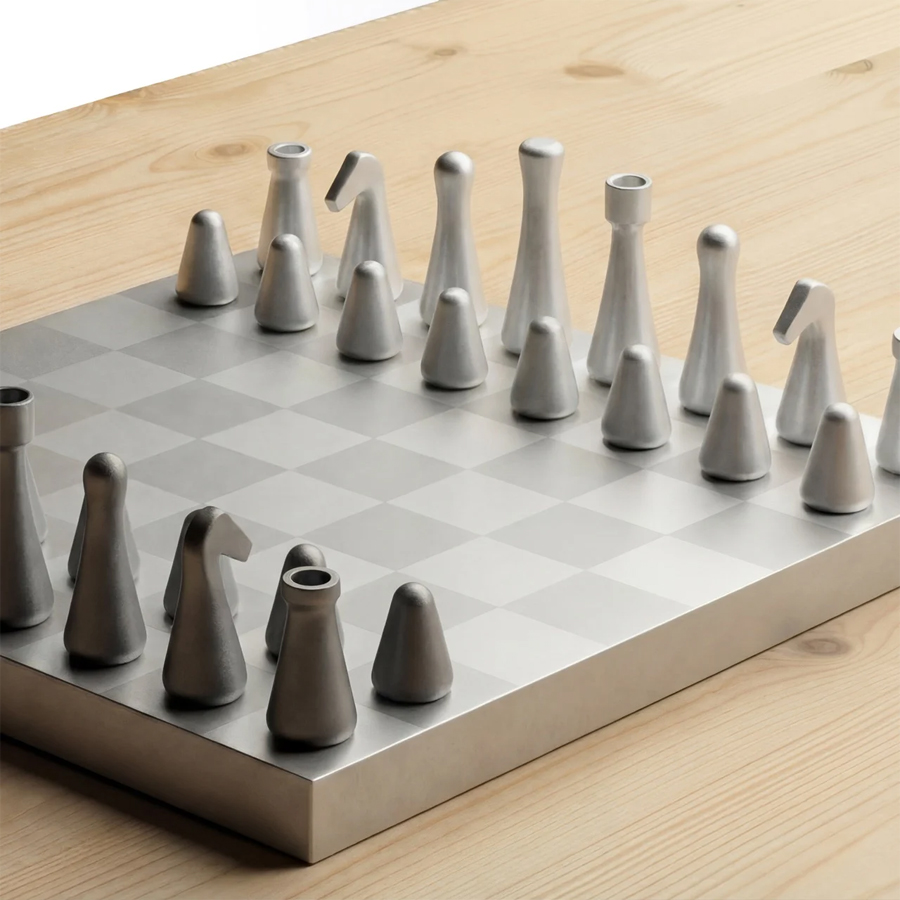
The Knight demonstrates this design philosophy particularly well. Traditionally represented by a detailed horse’s head, it is often the most expressive piece in a chess set. Reimagining that familiar form within a minimalist framework presents a significant challenge. Rather than reproducing the horse literally, Stoa captures its character through silhouette and proportion. The result is a piece that feels contemporary while retaining the personality and recognizability that players expect.
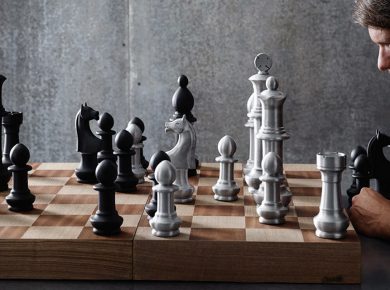
Material choice plays an equally important role in the set’s character. Every piece is CNC-machined from solid recycled aluminum, ensuring precision and durability. After machining, the surfaces undergo polishing and fine glass bead-blasting, producing a smooth matte texture that enhances the purity of the forms. A final anodized finish provides long-term protection while preserving the understated aesthetic.
The tactile qualities are just as carefully considered as the visual ones. Hidden brass weights give each piece a satisfying sense of mass, creating a deliberate feeling with every move. Leather pads beneath the bases add stability and help protect the board surface. Together, these details transform the simple act of moving a piece into a refined physical experience.
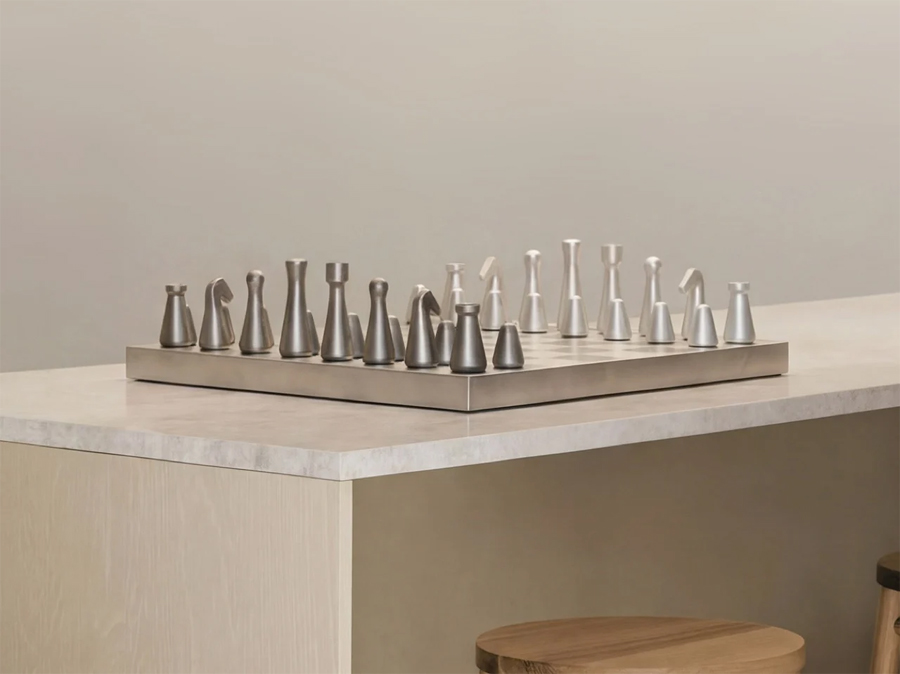
Despite its minimalist appearance, Stoa was not created through simplification alone. The development process involved extensive prototyping and testing to refine ergonomics, visual hierarchy, and piece recognition. Designers evaluated how comfortably the pieces could be handled and how effectively players could identify them during active gameplay. The challenge was not simply to make chess pieces look modern, but to ensure that every reduction enhanced rather than compromised functionality.
The set’s proportions further reinforce its balanced character. The King stands at 68 millimeters, followed by the Queen at 62 millimeters, the Bishop at 58 millimeters, the Knight at 52 millimeters, the Rook at 47 millimeters, and the Pawn at 32 millimeters. Paired with a 280-by-280-millimeter board, the overall composition feels compact, precise, and well suited to contemporary living spaces.

What ultimately makes Stoa compelling is its understanding of tradition. Rather than rejecting the history of chess, it studies the visual language that has evolved over centuries and translates it into a new form. The familiar hierarchy of the pieces remains intact, but it is expressed through geometry, proportion, and material rather than ornament.
The result is a chess set that functions on multiple levels. It is a practical tool for play, a carefully crafted design object, and an example of how minimalism can enhance rather than diminish meaning. In an age where many products compete for attention through excess, Stoa demonstrates the enduring power of restraint. Quiet, precise, and thoughtfully executed, it proves that sometimes the strongest design statement is knowing what to leave out.




1 comment
I saw one of these in Kazakhstan and I bought one.