Every autonomous vehicle concept being designed right now is wrestling with the same question. If nobody needs to drive, what does the interior become? The answers have been remarkably consistent: a lounge, a meeting room, a living space on wheels. Seats rotate. Tables appear. Everyone faces everyone else, pretending they are on a very expensive train. It is a reasonable answer. It is also, when you see it for the tenth time, a slightly uninspired one.
Seoul-based designer Seonmyeong Woo looked at that consensus and started from a different place entirely.
His Volkswagen ID. Counterpoint concept, developed across the first half of 2024, poses a question that the lounge-on-wheels response never quite addresses: what if the people sitting in the front and rear of a car do not want the same thing from their journey? Not just slightly different preferences, but fundamentally different relationships to the space they are in, the world outside, and the experience of being in a moving vehicle at all? The Counterpoint is built on the argument that those two conditions deserve two genuinely different environments – not a compromise, but a separation.
The concept is grounded in a Level 5 autonomous driving scenario, the SAE designation for full, unconditional self-driving with no human input required under any circumstances. That designation matters not just as a technical premise but as a design liberation. At Level 5, the designer argues, the probability of accidents drops to a point where materials and structural decisions previously constrained by crash safety logic become available. As Volkswagen itself has been exploring through its Gen.Urban research vehicle – currently being tested on public roads in Wolfsburg – the elimination of the steering wheel and pedals opens up fundamental questions about how people experience being in a vehicle, how they spend their time, and how the space around them should be organised. Woo’s concept takes those questions further than most.
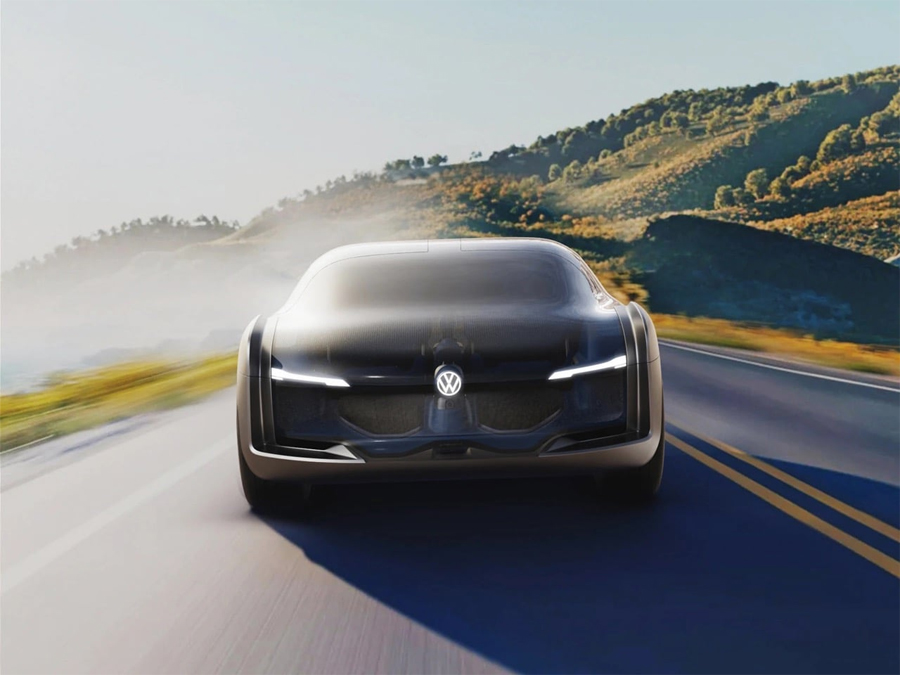
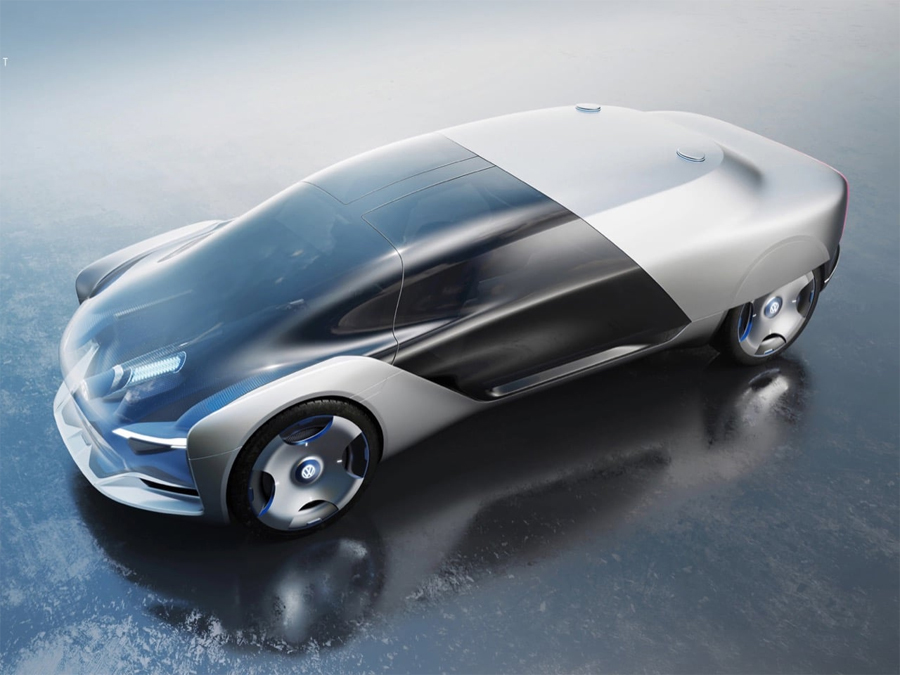
The front zone, which Woo calls Open Window, uses a mono-volume form with a fully reclining posture. The windshield is entirely glazed and doubles as an AR surface, so the occupant lies back and looks upward and forward through a transparent canopy. The effect, in the renders, is less like sitting in a car and more like lying in an observatory – a direct, almost unmediated relationship with the environment outside.
The rear zone, called Private Wall, is the opposite in almost every respect. A notchback configuration wraps the occupants in an opaque body section that creates a large, enclosed private space – something closer to a room than a seat. The visual language references the kind of customisable wall found in premium domestic interiors. There is no transparency, no connection to what is outside. The occupant is simply somewhere quiet and contained.
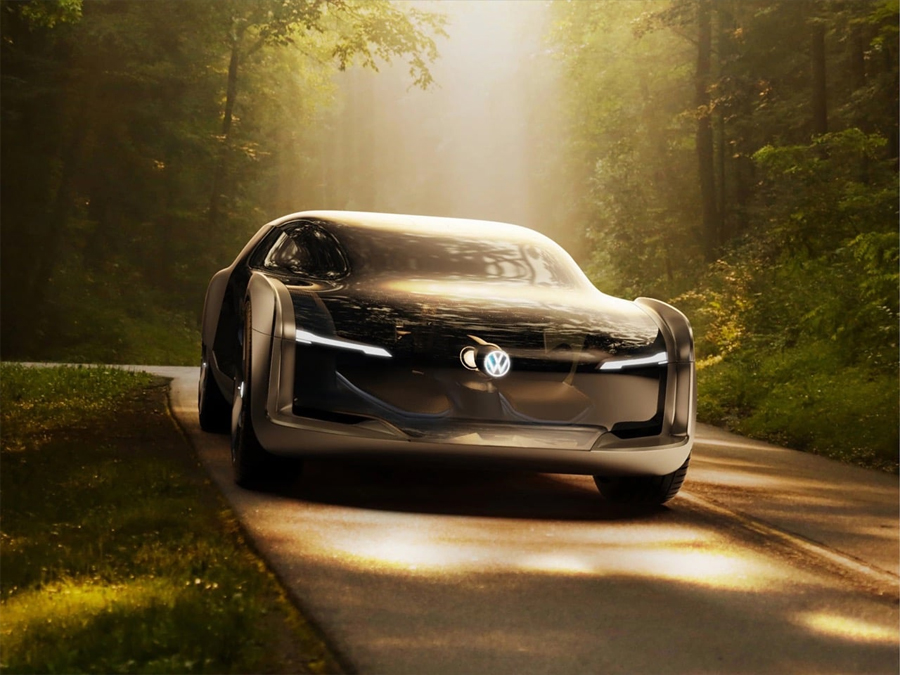
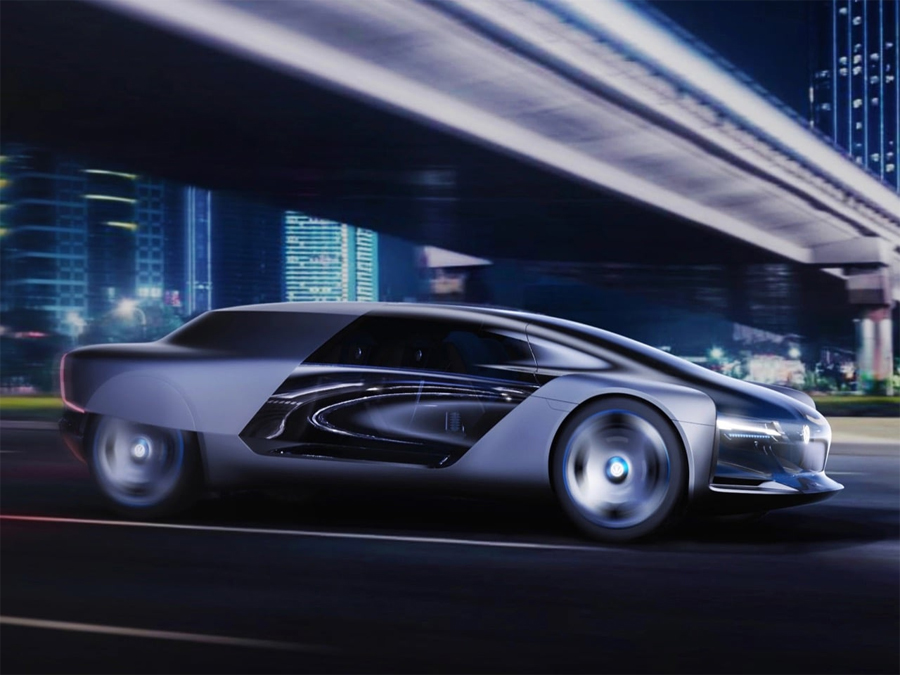
What makes the concept genuinely coherent rather than merely conceptual is that the exterior form is a direct expression of this interior logic. The hard material boundary between the two zones falls at roughly the B-pillar, with the forward half of the car clad in glassy, translucent surfaces and the rear half wrapped in opaque, sculpted bodywork. The wheels are enclosed in turbine-style rims that give the whole vehicle a sealed, monolithic quality from the outside. You would not know, looking at the car in a forest or on a wet urban expressway at night, that it contains two completely different spatial experiences. That is the point: one coherent object, two independent interior worlds.
The portfolio documentation reveals how much iterative work went into arriving at this outcome. Dozens of sketch directions explored different window placements and body configurations, several of which were rejected precisely because they created visual continuity between the two rows – which would have undermined the concept’s core argument. The final resolution draws a clear commitment: once the decision was made that the front and rear should be genuinely separate, every design decision was made in service of that separation rather than in spite of it.
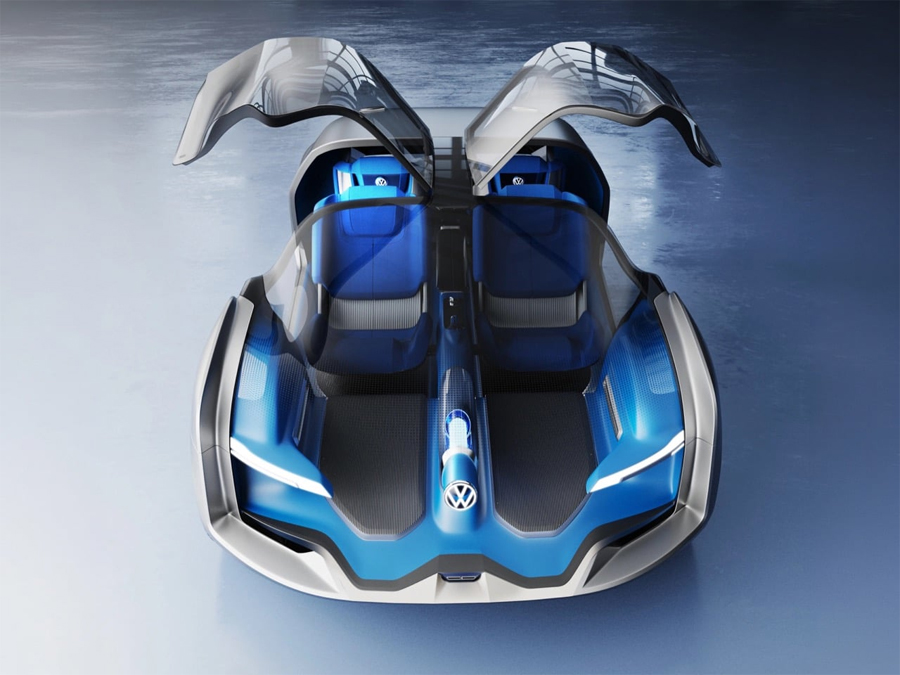
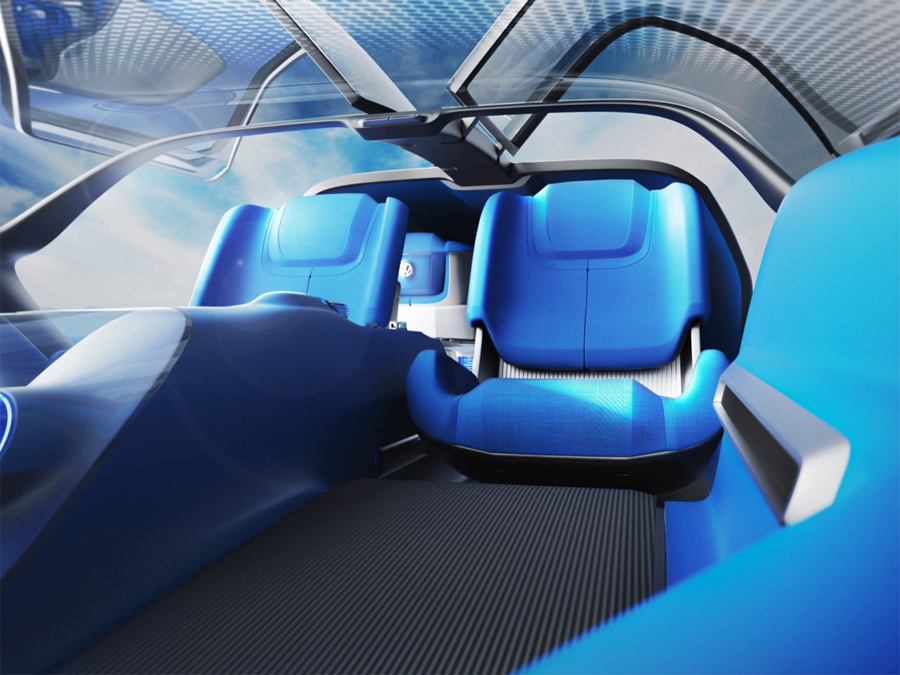
Interior renders show the cabin upholstered in a saturated cobalt blue with carbon-weave floor surfaces – a quality that sits between automotive and industrial design, and reads as intentional rather than merely futuristic. Gullwing panels in the hero overhead render open to expose both rows simultaneously, a theatrical gesture clearly specific to the concept context but effective at communicating the spatial relationship between the zones in a way that floor plans and section drawings never quite achieve.
The broader autonomous vehicle design conversation has largely assumed that removing the driver creates a single, unified social space – that the absence of a steering wheel automatically produces togetherness. The ID. Counterpoint questions that assumption without rejecting it. Its argument is not that people should always be separated in autonomous vehicles, but that they should be able to be – and that designing for that possibility produces a more honest, more interesting object than designing for a default condition that may not apply to most actual journeys.
The questions Volkswagen is exploring through its own research – how people spend their time in a self-driving vehicle, what digital content supports work, entertainment, or relaxation, and whether people simply feel comfortable – are exactly the questions that the Counterpoint answers through form rather than through features. Not with screens or rotating seats, but with walls and windows in the right places.
The ID. Counterpoint remains a student concept. What it demonstrates, quietly and with considerable conviction, is that the most interesting thinking about autonomous vehicles may not be happening in the large studios at all. But be sure to check the concept cars from largest automakers.